

Rat TGFBR2 Protein (Fc Tag)
TGFBR2
- 100ug (NPP3132) Please inquiry
| Catalog Number | P80139-R02H |
|---|---|
| Organism Species | Rat |
| Host | Human Cells |
| Synonyms | TGFBR2 |
| Molecular Weight | The recombinant rat TGFBR2/Fc is a disulfide-linked homodimer. The reduced monomer comprises 384 amino acids and has a predicted molecular mass of 43 kDa. The apparent molecular mass of the protein is approximately 54 kDa in SDS-PAGE under reducing conditions. |
| predicted N | Ile 24 |
| SDS-PAGE | 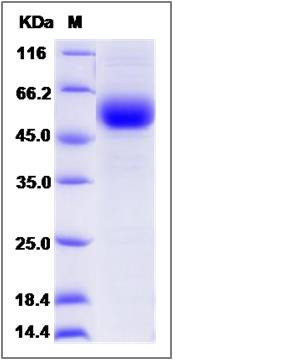 |
| Purity | > 95 % as determined by SDS-PAGE |
| Protein Construction | A DNA sequence encoding the rat TGFBR2 (P38438) (Met1-Gln166) was expressed, fused with the Fc region of human IgG1 at the C-terminus. |
| Bio-activity | |
| Research Area | Cardiovascular |Angiogenesis |Growth Factor & Receptor |Transforming Growth Factor Beta (TGF-beta) Superfamily |TGF-beta Superfamily Receptors |
| Formulation | Lyophilized from sterile PBS, pH 7.4 1. Normally 5 % - 8 % trehalose and mannitol are added as protectants before lyophilization. Specific concentrations are included in the hardcopy of COA. |
| Background | TGFBR2 is member of the Ser/Thr protein kinase family and the TGFB receptor subfamily. It is a transmembrane protein. TGFBR2 is comprised by a C-terminal protein kinase domain and an N-terminal ectodomain. The ectodomain consists of a compact fold containing nine beta-strands and a single helix stabilised by a network of six intra strand disulphide bonds. The folding topology includes a central five-stranded antiparallel beta-sheet, eight-residues long at its centre, covered by a second layer consisting of two segments of two-stranded antiparallel beta-sheets. TGFBR2 has a protein kinase domain, forms a heterodimeric complex with another receptor protein, and binds TGF-beta. This receptor/ligand complex phosphorylates proteins, which then enter the nucleus and regulate the transcription of a subset of genes related to cell proliferation. Mutations in TGFBR2 gene have been associated with Marfan syndrome, Loeys-Deitz Aortic Aneurysm Syndrome, and the development of various types of tumors. TGFBR2 attenuates the biological activities of TGF-beta in colorectal cancer. TGFBR2 expression is increased in oral squamous cell carcinoma cells. Its expression is decreased by IL-1beta while inducing Sp3 via NFkappaB. TGFB2 and TGFBR2 are involved in the antiestrogenic activity. |
| Reference |