

Rat PD-L1 / B7-H1 / CD274 Protein (His Tag)
CD274
- 100ug (NPP1079) Please inquiry
| Catalog Number | P80450-R08H |
|---|---|
| Organism Species | Rat |
| Host | Human Cells |
| Synonyms | CD274 |
| Molecular Weight | The recombinant rat CD274 comprises 232 amino acids and predicts a molecular mass of 26.5 kDa. The apparent molecular mass of the recombinant protein is approximately 50.7 kDa in SDS-PAGE under reducing conditions. |
| predicted N | Ala 18 |
| SDS-PAGE | 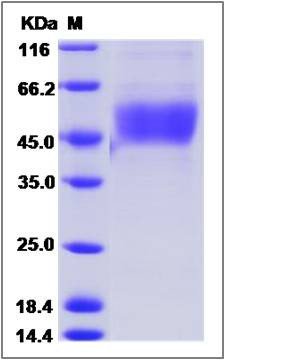 |
| Purity | > 95 % as determined by SDS-PAGE |
| Protein Construction | A DNA sequence encoding the rat CD274 (NP_001178883.1)(Met1-Thr238) was expressed with a polyhistidine tag at the C-terminus. |
| Bio-activity | |
| Research Area | Immunology |Innate Immunity |Monocytes/Macrophages |Macrophage Markers |
| Formulation | Lyophilized from sterile PBS, pH 7.4. 1. Normally 5 % - 8 % trehalose, mannitol and 0.01% Tween80 are added as protectants before lyophilization. Specific concentrations are included in the hardcopy of COA. |
| Background | Programmed death-1 ligand-1 (PD-L1, CD274, B7-H1) has been identified as the ligand for the immunoinhibitory receptor programmed death-1(PD1/PDCD1) and has been demonstrated to play a role in the regulation of immune responses and peripheral tolerance. PD-L1/B7-H1 is a member of the growing B7 family of immune molecules and this protein contains one V-like and one C-like Ig domain within the extracellular domain, and together with PD-L2, are two ligands for PD1 which belongs to the CD28/CTLA4 family expressed on activated lymphoid cells. By binding to PD1 on activated T-cells and B-cells, PD-L1 may inhibit ongoing T-cell responses by inducing apoptosis and arresting cell-cycle progression. Accordingly, it leads to growth of immunogenic tumor growth by increasing apoptosis of antigen specific T cells and may contribute to immune evasion by cancers. PD-L1 thus is regarded as promising therapeutic target for human autoimmune disease and malignant cancers. |
| Reference |