

Rat ICOS Ligand / B7-H2 Protein (His Tag)
ICOSLG
- 100ug (NPP1023) Please inquiry
| Catalog Number | P81346-R08H |
|---|---|
| Organism Species | Rat |
| Host | Human Cells |
| Synonyms | ICOSLG |
| Molecular Weight | The recombinant rat ICOSLG consists 250 amino acids and predicts a molecular mass of 28.6 kDa. |
| predicted N | Glu 25 |
| SDS-PAGE | 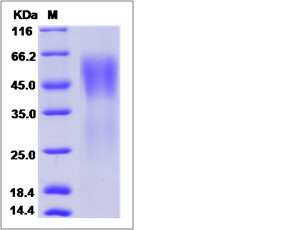 |
| Purity | > 95 % as determined by SDS-PAGE |
| Protein Construction | A DNA sequence encoding the rat ICOSLG (XP_006223893.1) (Met1-Lys261) was expressed with a polyhistidine tag at the C-terminus. |
| Bio-activity | |
| Research Area | Immunology |Adaptive Immunity |Costimulation & Costimulatory Molecule |B7/CD28 Family |
| Formulation | Lyophilized from sterile PBS, pH 7.4. 1. Normally 5 % - 8 % trehalose and mannitol are added as protectants before lyophilization. Specific concentrations are included in the hardcopy of COA. |
| Background | Inducible co-stimulator ligand (ICOSL), also known as B7-H2, is a member of the B7 family of co-stimulatory molecules related to B7-1 and B7-2. It is a transmembrane glycoprotein with extracellular IgV and IgC domains, and binds to ICOS on activated T cells, thus delivers a positive costimulatory signal for optimal T cell function. The structural features of ICOSL are crucial for its costimulatory function. Present study shows that ICOSL displays a marked oligomerization potential, resembling more like B7-1 than B7-2. B7-H2-dependent signaling may play an active role in a proliferative response rather than in cytokine and chemokine production. The CD28/B7 and ICOS/B7-H2 pathways are both critical for costimulating T cell immune responses. Deficiency in either pathway results in defective T cell activation, cytokine production and germinal center formation. |
| Reference |