

Mouse TSLP Protein (His Tag)
TSLP
- 100ug (NPP1599) Please inquiry
| Catalog Number | P51005-M08H |
|---|---|
| Organism Species | Mouse |
| Host | Human Cells |
| Synonyms | TSLP |
| Molecular Weight | The secreted recombinant mouse TSLP comprises 132 amino acids and has a calculated molecular mass of 15.4 kDa. As a result of glycosylation, the apparent molecular mass of the recombinant protein is approximately 22-27 kDa in SDS-PAGE under reducing conditions. |
| predicted N | Tyr 20 |
| SDS-PAGE | 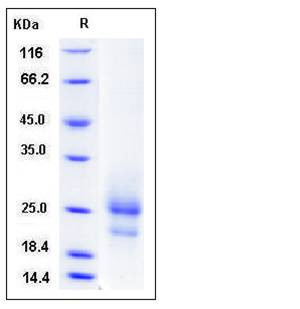 |
| Purity | > 90 % as determined by SDS-PAGE |
| Protein Construction | A DNA sequence encoding the mouse TSLP (Q9JIE6) (Met 1-Glu 140) was expressed, with a C-terminal polyhistidine tag. |
| Bio-activity | Measured by its ability to bind human IL7RA-his in functional ELISA. |
| Research Area | Immunology |Adaptive Immunity |Costimulation & Costimulatory Molecule |Other Costimulatory Molecules |
| Formulation | Lyophilized from sterile PBS, pH 7.4 1. Normally 5 % - 8 % trehalose and mannitol are added as protectants before lyophilization. Specific concentrations are included in the hardcopy of COA. |
| Background | Thymic stromal lymphopoietin (TSLP) is an interleukin 7 (IL-7)-like cytokine originally characterized by its ability to promote the activation of B cells and dendritic cells (DCs). Thymic stromal lymphopoietin (TSLP) is a cytokine expressed by epithelial cells, including keratinocytes, and is important in allergic inflammation. Subsequent studies have shown that TSLP promotes T helper type 2 (TH2) cell responses associated with immunity to some helminth parasites and the pathogenesis of many inflammatory diseases, including atopic dermatitis and asthma. TSLP can promote TH2 cytokine-associated inflammation by directly promoting the effector functions of CD4+ TH2 cells, basophils and other granulocyte populations while simultaneously limiting the expression of DC-derived proinflammatory cytokines and promoting regulatory T cell responses in peripheral tissues. |
| Reference |