

Mouse R-Spondin 1 / RSPO1 Protein (His Tag)
R-spondin,Rspondin
- 100ug (NPP1581) Please inquiry
| Catalog Number | P50316-M08S |
|---|---|
| Organism Species | Mouse |
| Host | CHO Stable Cells |
| Synonyms | R-spondin,Rspondin |
| Molecular Weight | The secreted recombinant mouse RSPO1 comprises 256 amino acids with a predicted molecular mass of 28.5 kDa. As a result of glycosylation, the apparent molecular mass of the protein is approximately 44 kDa in SDS-PAGE under reducing conditions. |
| predicted N | Ser 21 |
| SDS-PAGE | 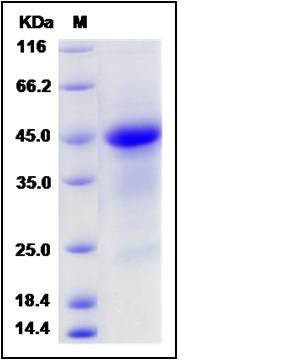 |
| Purity | > 95 % as determined by SDS-PAGE |
| Protein Construction | A DNA sequence encoding the full length of mouse RSPO1 (NP_619624.2) (Met 1-Gln 265) was fused with a polyhistidine tag at the C-terminus. |
| Bio-activity | Measured by its ability to induce activation of β-catenin response in a Topflash Luciferase assay using HEK293T human embryonic kidney cells. The ED50 for this effect is typically 50-200 ng/ml in the presence of 50 ng/ml recombinant mouse Wnt3a. |
| Research Area | Signaling |Signal Transduction |Growth Factor & Receptor |R-Spondin Protein |
| Formulation | Lyophilized from sterile PBS, pH 7.4 1. Normally 5 % - 8 % trehalose, mannitol and 0.01% Tween80 are added as protectants before lyophilization. Specific concentrations are included in the hardcopy of COA. |
| Background | RSPO1 gene is a member of the R-spondin family. It encodes RSPO1 which is known as a secreted activator protein with two cystein-rich, furin-like domains and one thrombospondin type 1 domain. In mice, RSPO1 induces the rapid onset of crypt cell proliferation and increases intestinal epithelial healing, providing a protective effect against chemotherapy-induced adverse effects. This protein is an activator of the beta-catenin signaling cascade, leading to TCF-dependent gene activation. RSPO1 acts both in the canonical Wnt/beta-catenin-dependent pathway and in non-canonical Wnt signaling pathway, probably by acting as an inhibitor of ZNRF3, an important regulator of the Wnt signaling pathway. It also acts as a ligand for frizzled FZD8 and LRP6. |
| Reference |