

Mouse LAG3 / CD223 / Lymphocyte activation gene 3 Protein (His Tag)
CD223,LAG-3,Ly66
- 100ug (NPP1661) Please inquiry
| Catalog Number | P53069-M08H3 |
|---|---|
| Organism Species | Mouse |
| Host | Human Cells |
| Synonyms | CD223,LAG-3,Ly66 |
| Molecular Weight | The recombinant mouse LAG3 consists of 420 amino acids and predicts a molecular mass of 45.7 kDa. |
| predicted N | Gly 24 |
| SDS-PAGE | 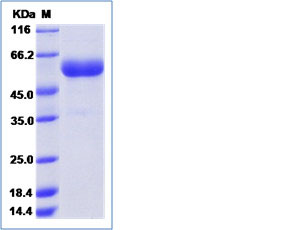 |
| Purity | > 95 % as determined by SDS-PAGE. |
| Protein Construction | A DNA sequence encoding the mouse LAG3 (NP_032505.1) (Met1-Arg432) was expressed with a polyhistidine tag at the C-terminus. |
| Bio-activity | |
| Research Area | Immunology |Inflammation / Inflammatory Mediator |Inflammatory Cytokines & Chemoki and Receptors |IL-12 Family |
| Formulation | Lyophilized from sterile PBS, pH 7.4. 1. Normally 5 % - 8 % trehalose and mannitol are added as protectants before lyophilization. Specific concentrations are included in the hardcopy of COA. |
| Background | LAG3, also known as CD223 and Lymphocyte activation gene 3, belongs to immunoglobulin (Ig) superfamily. LAG3 contains 4 extracellular Ig-like domains. The LAG3 gene contains 8 exons. It is selectively expressed in activated T and NK cells. LAG3 has a negative regulatory function in T cells. It also acts as as a new marker of T cell induced B cell activation. As a soluble molecule, LAG3 activates antigen-presenting cells through MHC class II signalling, leading to increased antigen-specific T-cell responses in vivo. |
| Reference |