

Mouse IFNGR2 Protein (His Tag)
Ifgr2, Ifgt
- 100ug (NPP3360) Please inquiry
| Catalog Number | P50665-M08H |
|---|---|
| Organism Species | Mouse |
| Host | Human Cells |
| Synonyms | Ifgr2, Ifgt |
| Molecular Weight | The secreted recombinant mouse IFNGR2 comprises 234 amino acids and has a calculated molecular mass of 26.7 kDa. As a result of glycosylation, the apparent molecular mass of the recombinant protein is approximately 40-45 kDa in SDS-PAGE under reducing conditions. |
| predicted N | Ser 20 |
| SDS-PAGE | 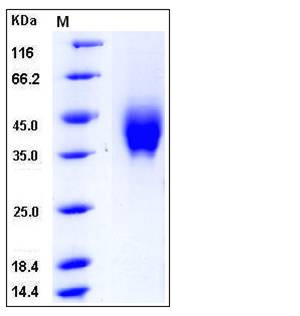 |
| Purity | > 97 % as determined by SDS-PAGE |
| Protein Construction | A DNA sequence encoding the extracellular domain of mouse IFNGR2 (NP_032364.1) (Met 1-Val 243) was expressed, with a C-terminal polyhistidine tag. |
| Bio-activity | |
| Research Area | Developmental Biology |Metabolism |Types of disease |Metabolism in Obesity |
| Formulation | Lyophilized from sterile PBS, pH 7.4 1. Normally 5 % - 8 % trehalose and mannitol are added as protectants before lyophilization. Specific concentrations are included in the hardcopy of COA. |
| Background | Interferon gamma receptor beta chain (IFNgammaR2), also known as IFNGR2, belongs to the type II cytokine receptor family, whose deficiency is a cause of autosomal recessive mendelian susceptibility to mycobacterial disease (MSMD), also known as familial disseminated atypical mycobacterial infection. This accessory factor is an integral part of the IFN-gamma signal transduction pathway and is likely to interact with GAF, JAK1, and/or JAK2. IFNGR2 is a component of the IFNgamma receptor complex along with the IFNgammaR alpha chain (IFNGR1), and is a new Bax suppressor. The C-terminal fragment (cytoplasmic domain) of IFNgammaR2 is expressed in human cancer cell lines of megakaryocytic cancer (DAMI), breast cancer (MDA-MD-468), and prostate cancer (PC3 cells). The Th1 cytokine IFNgamma, acting through its heterodimeric receptors, IFNgammaR1 and IFNgammaR2, in the induction/proliferation of Th1 cells, might suppress the Th2 responses that may underlie atopic asthma. IFNGR2 has always been seen as a key mechanism for shielding T lymphocytes from the antiproliferative effects of the IFNgamma-signal transducer and activator of transcription 1 (STAT1) pathway. |
| Reference |
IFNGR2 related areas, pathways, and other information |