

Mouse EGFR / HER1 / ErbB1 Protein (His Tag)
9030024J15Rik,AI552599,Erbb,Errb1,Errp,wa-2,wa2,Wa5
- 100ug (NPP1243) Please inquiry
| Catalog Number | P51091-M08H |
|---|---|
| Organism Species | Mouse |
| Host | Human Cells |
| Synonyms | 9030024J15Rik,AI552599,Erbb,Errb1,Errp,wa-2,wa2,Wa5 |
| Molecular Weight | The secreted recombinant mouse EGFR comprises 634 amino acids and has a calculated molecular mass of 71 kDa. As a result of glycosylation, the apparent molecular mass of rmEGFR is approximately 100 kDa in SDS-PAGE under reducing conditions. |
| predicted N | Leu 25 |
| SDS-PAGE | 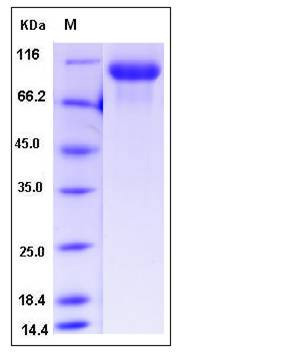 |
| Purity | > 95 % as determined by SDS-PAGE |
| Protein Construction | A DNA sequence encoding the extracellular domain of mouse EGFR (Q01279) (Met 1-Ser 647) was fused with a polyhistidine tag at the C-terminus. |
| Bio-activity | 1. Measured by its binding ability in a functional ELISA. 2. Immobilized mouse EGFR-his at 10 μg/mL (100 μl/well) can bind human EGF-Fc (P10605-H01H), The EC50 of human EGF-Fc (P10605-H01H) is 60-90 ng/mL. 3. Immobilized mouse EGFR-his at 10 μg/mL (100 μl/well) can bind mouse EGF-Fc (P50482-M01H), The EC50 of mouse EGF-Fc (P50482-M01H) is 70-100 ng/mL. |
| Research Area | Signaling |Signal Transduction |Protein Phosphorylation |Tyrosine Kinase |Receptor Tyrosine Kinases |
| Formulation | Lyophilized from sterile PBS, pH 7.4 1. Normally 5 % - 8 % trehalose and mannitol are added as protectants before lyophilization. Specific concentrations are included in the hardcopy of COA. |
| Background | As a member of the epidermal growth factor receptor (EGFR) family, EGFR protein is type I transmembrane glycoprotein that binds a subset of EGF family ligands including EGF, amphiregulin, TGF-α, betacellulin, etc. EGFR protein plays a crucial role in signaling pathway in the regulation of cell proliferation, survival and differentiation. Binding of a ligand induces EGFR protein homo- or heterodimerization, the subsequent tyrosine autophosphorylation and initiates various down stream pathways (MAPK, PI3K/PKB and STAT). In addition, EGFR signaling also has been shown to exert action on carcinogenesis and disease progression, and thus EGFR protein is proposed as a target for cancer therapy currently. |
| Reference |