

Mouse CD40 / TNFRSF5 Protein (His & Fc Tag)
AI326936,Bp50,GP39,HIGM1,IGM,IMD3,p50,T-BAM,Tnfrsf5,TRAP
- 100ug (NPP1033) Please inquiry
| Catalog Number | P50324-M03H |
|---|---|
| Organism Species | Mouse |
| Host | Human Cells |
| Synonyms | AI326936,Bp50,GP39,HIGM1,IGM,IMD3,p50,T-BAM,Tnfrsf5,TRAP |
| Molecular Weight | The secreted recombinant mouse CD40/Fc is a disulfide-linked homodimer The reduced monomer comprises 422 amino acids and has a predicted molecular mass of 47 kDa. As a result of glycosylation, it migrates as an approximately 57 kDa band in SDS-PAGE under reducing conditions. |
| predicted N | Leu 20 |
| SDS-PAGE | 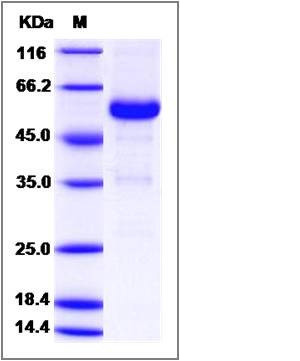 |
| Purity | > 90 % as determined by SDS-PAGE |
| Protein Construction | A DNA sequence encoding the extracellular domain of mouse CD40 isoform 1 (P27512-1) (Met 1-Arg 193) was fused with the C-terminal polyhistidine-tagged Fc region of human IgG1 at the C-terminus. |
| Bio-activity | Measured by its ability to bind recombinant human CD40L in a functional ELISA. |
| Research Area | Immunology |Innate Immunity |Cytokine |TNF Superfamily |Processes Regulated by TNF Superfamily Members |Regulation of T Cell Co-stimulation by TNF Superfamily Members | |
| Formulation | Lyophilized from sterile PBS, pH 7.4 1. Normally 5 % - 8 % trehalose and mannitol are added as protectants before lyophilization. Specific concentrations are included in the hardcopy of COA. |
| Background | CD40, also known as TNFRSF5, is a member of the TNF receptor superfamily which are single transmembrane-spanning glycoproteins. CD40 protein plays an essential role in mediating a broad variety of immune and inflammatory responses including T cell-dependent immunoglobulin class switching, memory B cell development, and germinal center formation. CD40 protein is expressed in B cells, dendritic cells, macrophages, endothelial cells, and several tumor cell lines. Defects in CD40 result in hyper-IgM immunodeficiency type 3 (HIGM3). In addition, CD40/CD40L interaction is found to be necessary for amyloid-beta-induced microglial activation, and thus is thought to be an early event in Alzheimer disease pathogenesis. |
| Reference |