

Mouse Biglycan / PG-S1 / BGN Protein (Fc Tag)
BG,DSPG1,PG-S1,PGI,SLRR1A
- 100ug (NPP1082) Please inquiry
| Catalog Number | P50766-M02H |
|---|---|
| Organism Species | Mouse |
| Host | Human Cells |
| Synonyms | BG,DSPG1,PG-S1,PGI,SLRR1A |
| Molecular Weight | The recombinant mouse BGN /Fc is a disulfide-linked homodimer. The reduced monomer comprises 591 amino acids and has a predicted molecular mass of 66.5 KDa. The apparent molecular mass of the protein is approximately 67 KDa in SDS-PAGE under reducing conditions due to glycosylation. |
| predicted N | Glu 20 |
| SDS-PAGE | 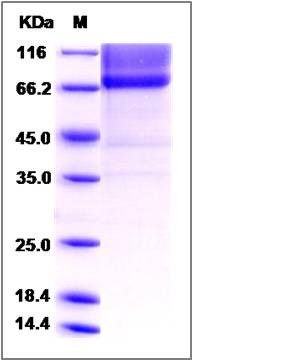 |
| Purity | > 85 % as determined by SDS-PAGE |
| Protein Construction | A DNA sequence encoding the mouse BGN (Met1-Lys369) was expressed with the Fc region of human IgG1 at the C-terminus. |
| Bio-activity | |
| Research Area | Developmental Biology |Embryogenesis |Germ Layer Formation |Mesoderm Marker |
| Formulation | Lyophilized from sterile PBS, pH 7.4. 1. Normally 5 % - 8 % trehalose, mannitol and 0.01% Tween80 are added as protectants before lyophilization. Specific concentrations are included in the hardcopy of COA. |
| Background | Biglycan, also known as PG-S1 and BGN, is a a small leucine-rich repeat proteoglycan (SLRP). It can be detected in a variety of extracellular matrix tissues, including bone, cartilage and tendon. Biglycan consists of a protein core containing leucine-rich repeat regions and two glycosaminoglycan (GAG) chains consisting of either chondroitin sulfate (CS) or dermatan sulfate (DS). Non-glycanated forms of biglycan (no GAG chains) increase with age in human articular cartilage. Biglycan interacts with collagen, both via the core protein and GAG chains. Biglycan plays a role in the mineralisation of bone. Biglycan core protein binds to the growth factors BMP-4 and influences its bioactivity. |
| Reference |