

Human pro form of IL18 / Interleukin 18 / IGIF Protein (GST Tag)(Inactive)
IGIF,IL-18,IL-1g,IL1F4,Interleukin 18
- 100ug (NPP4014) Please inquiry
| Catalog Number | P10119-H09E |
|---|---|
| Organism Species | Human |
| Host | E. coli |
| Synonyms | IGIF,IL-18,IL-1g,IL1F4,Interleukin 18 |
| Molecular Weight | The recombinant pro form of human IL18 consists of 419 amino acids and has a predicted molecular mass of 48.6 kDa. |
| predicted N | Met |
| SDS-PAGE | 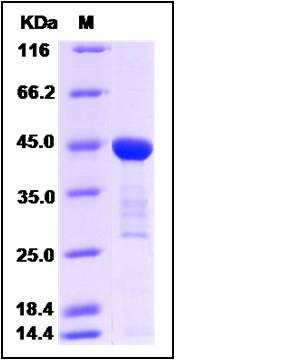 |
| Purity | > 85 % as determined by SDS-PAGE |
| Protein Construction | A DNA sequence encoding the pro form of human IL18 (Q14116) (Met1-Asp193) was fused with the GST tag at the N-terminus. |
| Bio-activity | |
| Research Area | Cancer |Cancer immunology |Cytokine & Receptor |Interleukin & Receptor |IL-1 family & Receptor |IL-1 family ligand | |
| Formulation | Lyophilized from sterile PBS, pH 7.5 1. Normally 5 % - 8 % trehalose and mannitol are added as protectants before lyophilization. Specific concentrations are included in the hardcopy of COA. |
| Background | Interleukin-18 (IL-18, also known as interferon-gamma inducing factor) is a proinflammatory cytokine that belongs to the IL-1 superfamily and is produced by macrophages and other cells. This cytokine can induce the IFN-gamma production of T cells. The combination of IL-18 and IL12 has been shown to inhibit IL4 dependent IgE and IgG1 production, and enhance IgG2a production of B cells. IL-18 binding protein (IL18BP) can specifically interact with this cytokine, and thus negatively regulate its biological activity. IL-18 is an IL-1−like cytokine that requires cleavage with caspase-1 to become active, was found to increase IgE production in a CD4+ T cells-, IL-4− and STAT6−dependent fashion. IL-18 and T cell receptor−mediated stimulation could induce naïve CD4+ T cells to develop into IL-4−producing cells in vitro. Thus, caspase-1 and IL-18 may be critical in regulation of IgE production in vivo, providing a potential therapeutic target for allergic disorders. IL-18 production in primary synovial cultures and purified synovial fibroblasts was, in turn, upregulated by TNF-α and IL-1β, suggesting that monokine expression can feed back to promote Th1 cell development in synovial membrane. Besides, synergistic combinations of IL-18, IL-12, and IL-15 may be of importance in sustaining both Th1 responses and monokine production in RA. |
| Reference |