

Human Uracil-DNA glycosylase / UNG Protein (GST Tag)
DGU,HIGM4,HIGM5,UDG,UNG1,UNG15,UNG2
- 100ug (NPP4371) Please inquiry
| Catalog Number | P12939-H09E |
|---|---|
| Organism Species | Human |
| Host | E. coli |
| Synonyms | DGU,HIGM4,HIGM5,UDG,UNG1,UNG15,UNG2 |
| Molecular Weight | The recombinant human UNG/GST chimera consists of 452 amino acids and has a predicted molecular mass of 52 kDa. It migrates as an approxiamtely 48 kDa band in SDS-PAGE under reducing conditions. |
| predicted N | Met |
| SDS-PAGE | 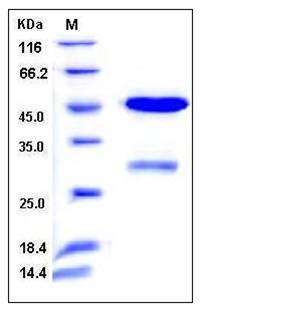 |
| Purity | > 90 % as determined by SDS-PAGE |
| Protein Construction | A DNA sequence encoding the human UNG isoform 1 (P13051-2) (Phe 85-Leu 304) was fused with the GST tag at the N-terminus. |
| Bio-activity | |
| Research Area | Developmental Biology |Post embryonic development |Cellular Senescence & Aging |DNA Repair |Base Excision Repair |
| Formulation | Lyophilized from sterile 40mM Tris, 0.15M NaCl, 2mM GSH, pH 7.5 1. Normally 5 % - 8 % trehalose and mannitol are added as protectants before lyophilization. Specific concentrations are included in the hardcopy of COA. |
| Background | Isoform 1 is widely expressed with the highest expression in skeletal muscle, heart and testicles. Isoform 2 has the highest expression levels in tissues containing proliferating cells. Uracil-DNA glycosylase exists in two forms: mitochondrial uracil-DNA glycosylase 1 (UNG1) and nuclear uracil-DNA glycosylase 2 (UNG2). uracil-DNA glycosylase. This gene encodes one of several uracil-DNA glycosylases. One important function of uracil-DNA glycosylases is to prevent mutagenesis by eliminating uracil from DNA molecules by cleaving the N-glycosylic bond and initiating the base-excision repair (BER) pathway. Uracil bases occur from cytosine deamination or misincorporation of dUMP residues. Alternative promoter usage and splicing of this gene leads to two different isoforms: the mitochondrial UNG1 and the nuclear UNG2. The UNG2 term was used as a previous symbol for the CCNO gene (GeneID 10309), which has been confused with this gene, in the literature and some databases. Defects in UNG are a cause of immunodeficiency with hyper-IgM type 5 (HIGM5). A rare immunodeficiency syndrome characterized by normal or elevated serum IgM levels with absence of IgG, IgA, and IgE. It results in a profound susceptibility to bacterial infections. |
| Reference |