

Human STX3 / Syntaxin 3 Protein (His Tag)
STX3A
- 100ug (NPP2522) Please inquiry
| Catalog Number | P14625-H07E |
|---|---|
| Organism Species | Human |
| Host | E. coli |
| Synonyms | STX3A |
| Molecular Weight | The recombinant human STX3 consists of 278 amino acids and predicts a molecular mass of 32.4 KDa. It migrates as an approximately 37 KDa band in SDS-PAGE under reducing conditions. |
| predicted N | His |
| SDS-PAGE | 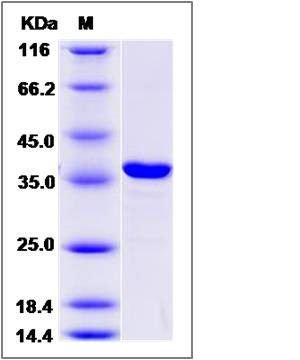 |
| Purity | > 90 % as determined by SDS-PAGE |
| Protein Construction | A DNA sequence encoding the human STX3 (NP_004168.1) (Met1-Asn289) was expressed with a polyhistidine tag at the N-terminus. |
| Bio-activity | |
| Research Area | Immunology |Signal Transduction |Protein Trafficking |Vesicle Transport |SNAPs & SNAREs |
| Formulation | Lyophilized from sterile 50mM Tris, 10% glycerol, pH 8.0. 1. Normally 5 % - 8 % trehalose and mannitol are added as protectants before lyophilization. Specific concentrations are included in the hardcopy of COA. |
| Background | STX3, also known as syntaxin 3, belongs to the syntaxin family. STX3 is a target membrane protein (t-SNARE) which is needed for membrane fusion. Membrane fusion requires the formation of a complex between a vesicle protein (v-SNARE) and t-SNAREs. STX3, together with syntaxin 2, are predominantly localized at the plasma membrane. Syntaxin 2 cycles between the plasma membrane and the perinuclear compartment whereas syntaxin 3 cycles between the plasma membrane and the trans-Golgi network. It is possible that this cycling has an important role in the regulation of t-SNARE function. |
| Reference |