

Human SP-10 / ACRV1 Protein (His Tag)
D11S4365,SP-10,SPACA2
- 100ug (NPP3557) Please inquiry
| Catalog Number | P11789-H08H |
|---|---|
| Organism Species | Human |
| Host | Human Cells |
| Synonyms | D11S4365,SP-10,SPACA2 |
| Molecular Weight | The recombinant human ACRV1 consists of 255 amino acids and predictes a molecular mass of 27.3 kDa. In SDS-PAGE under reducing conditions, rhACRV1 migrates as an approximately 38 kDa band due to glycosylation. |
| predicted N | Gln 22 |
| SDS-PAGE | 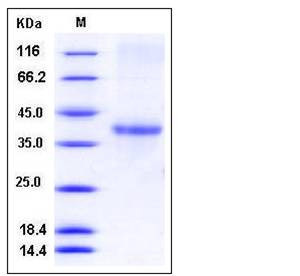 |
| Purity | > 90 % as determined by SDS-PAGE |
| Protein Construction | A DNA sequence encoding the mature form of human ACRV1 isoform 1 (P26436-1) (Gln 22-Ile 265) was fused with a polyhistidine tag at the C-terminus and a signal peptide at the N-terminus. |
| Bio-activity | |
| Research Area | Cancer |Cell cycle |Cell Differentiation |
| Formulation | Lyophilized from sterile PBS, pH 7.4 1. Normally 5 % - 8 % trehalose and mannitol are added as protectants before lyophilization. Specific concentrations are included in the hardcopy of COA. |
| Background | Acrosomal protein SP-10, also known as Acrosomal vesicle protein 1 and ACRV1, is a testis-specific, differentiation antigen, that arises within the acrosomal vesicle during spermatogenesis, and is associated with the acrosomal membranes and matrix of mature sperm. Regulation of cell type-specific gene transcription is central to cellular differentiation and development. During spermatogenesis, a number of testis-specific genes are expressed in a precise spatiotemporal order. The longest transcript of ACRV1 / SP-10 is the most abundant, comprising 53-72% of the total acrosomal vesicle protein 1 messages; the second largest transcript comprises 15-32%; the third and the fourth largest transcripts account for 3.4-8.3% and 8.7-12.5%, respectively; and the remaining transcripts combined account for < 1% of the total acrosomal vesicle protein 1 message. ACRV1 / SP-10 is a testis-specific acrosomal protein that has been detected in several species including humans. It may be involved in sperm-zona binding or penetration, and it is a potential contraceptive vaccine immunogen for humans. ACRV1 / SP-10 may be involved in sperm-zona binding or penetration. It is also a intra-acrosomal protein that is considered to be a vaccine candidate for immunocontraception. |
| Reference |