

Human SCG3 / Secretogranin 3 Protein (His Tag)
SGIII
- 100ug (NPP2480) Please inquiry
| Catalog Number | P16012-H08H |
|---|---|
| Organism Species | Human |
| Host | Human Cells |
| Synonyms | SGIII |
| Molecular Weight | The recombinant human SCG3 comprises 460 amino acids and has a predicted molecular mass of 52.4 kDa. The apparent molecular mass of the protein is approximately 54-63 kDa in SDS-PAGE under reducing conditions. |
| predicted N | Phe 20 |
| SDS-PAGE | 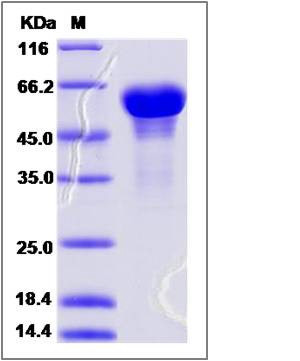 |
| Purity | > 95 % as determined by SDS-PAGE |
| Protein Construction | A DNA sequence encoding the human SCG3 (AAH14539.1) (Met1-Leu468) was expressed with a C-terminal polyhistidine tag. |
| Bio-activity | |
| Research Area | Signaling |Signal Transduction |Metabolism |Types of disease |Metabolism in Cancer |
| Formulation | Lyophilized from sterile PBS, pH 7.4. 1. Normally 5 % - 8 % trehalose and mannitol are added as protectants before lyophilization. Specific concentrations are included in the hardcopy of COA. |
| Background | SCG3, also known as secretogranin 3, is a member of the chromogranin/secretogranin family. Members of this family may serve as precursors for biologically active peptides. SCG3 is transported to secretory granules (SGs) in neuroendocrine cells. SCG3 binds strongly to chromogranin A (CgA) in an intragranular milieu and targets CgA to SGs in pituitary and pancreatic endocrine cells. With a sucrose density gradient of rat insulinoma-derived INS-1 cell homogenates, SgIII is localized to the SG fraction and is fractionated to the SG membrane (SGM) despite lacking the transmembrane region. |
| Reference | > |