

Human RAMP3 Protein (Fc Tag)
RAMP3
- 100ug (NPP2452) Please inquiry
| Catalog Number | P13744-H02H |
|---|---|
| Organism Species | Human |
| Host | Human Cells |
| Synonyms | RAMP3 |
| Molecular Weight | The recombinant human RAMP3 /Fc is a disulfide-linked homodimer. The reduced monomer comprises 336 amino acids and has a predicted molecular mass of 37.8 kDa. The apparent molecular mass of the protein is approximately 28-31 kDa in SDS-PAGE under reducing conditions. |
| predicted N | Arg 24 |
| SDS-PAGE | 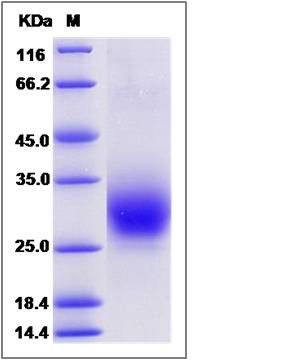 |
| Purity | > 95 % as determined by SDS-PAGE |
| Protein Construction | A DNA sequence encoding the human RAMP3 (Met1-Val118) was expressed with the Fc region of human IgG1 at the C-terminus. |
| Bio-activity | |
| Research Area | Cancer |Invasion microenvironment |Angiogenesis |Growth Factor & Receptor |Hormones |
| Formulation | Lyophilized from sterile PBS, pH 7.4 1. Normally 5 % - 8 % trehalose and mannitol are added as protectants before lyophilization. Specific concentrations are included in the hardcopy of COA. |
| Background | RAMP3 belongs to the RAMP family. Members of this family are single-transmembrane-domain proteins, called receptor (calcitonin) activity modifying proteins (RAMPs). RAMPs have a wide biological distribution; high concentrations are found in the brain, lung, liver, heart and spleen with lower expression levels present in the testes, gastrointestinal tract and thyroid. RAMPs are type I transmembrane proteins with an extracellular N terminus and a cytoplasmic C terminus. They are required to transport calcitonin-receptor-like receptor (CRLR) to the plasma membrane. CRLR, a receptor with seven transmembrane domains, can function as either a calcitonin gene-related peptide (CGRP) receptor or an adrenomedullin receptor, depending on which members of the RAMP family are expressed. In the presence of RAMP3 protein, CRLR functions as an adrenomedullin receptor. |
| Reference |