

Human PTGDS / L-PGDS Protein (His Tag)
L-PGDS,LPGDS,PDS,PGD2,PGDS,PGDS2
- 100ug (NPP2442) Please inquiry
| Catalog Number | P13346-H08H |
|---|---|
| Organism Species | Human |
| Host | Human Cells |
| Synonyms | L-PGDS,LPGDS,PDS,PGD2,PGDS,PGDS2 |
| Molecular Weight | The recombinant human PTGDS consists of 179 amino acids and predicts a molecular mass of 20.1 KDa. It migrates as an approximately 28 KDa band in SDS-PAGE under reducing conditions. |
| predicted N | Ala 23 |
| SDS-PAGE | 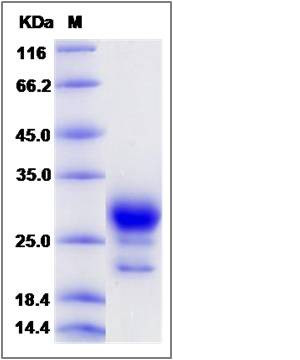 |
| Purity | > 80 % as determined by SDS-PAGE |
| Protein Construction | A DNA sequence encoding the human PTGDS (P41222) (Met1-Gln190) was expressed with a polyhistidine tag at the C-terminus. |
| Bio-activity | |
| Research Area | Cancer |Signal transduction |Signaling Pathway |Lipid Signaling |Prostaglandins |
| Formulation | Lyophilized from sterile PBS, pH 7.4 1. Normally 5 % - 8 % trehalose and mannitol are added as protectants before lyophilization. Specific concentrations are included in the hardcopy of COA. |
| Background | PTGDS, also known as L-PGDS, belongs to the calycin superfamily,lipocalin family. Lipocalins share limited regions of sequence homology and a common tertiary structure architecture. They transport small hydrophobic molecules such as steroids, bilins, retinoids, and lipids. PTGDS is a glutathione-independent prostaglandin D synthase that catalyzes the conversion of PGH2 to PGD2. It is involved in smooth muscle contraction/relaxation and a variety of central nervous system functions. PTGDS may have an anti-apoptotic role in oligodendrocytes. It binds small non-substrate lipophilic molecules, including biliverdin, bilirubin, retinal, retinoic acid and thyroid hormone, and may act as a scavenger for harmful hydrophopic molecules and as a secretory retinoid and thyroid hormone transporter. It is likely to play important roles in both maturation and maintenance of the central nervous system and male reproductive system. |
| Reference |