

Human Iduronate 2-Sulfatase / IDS Protein (His Tag)
IDS,MPS2,SIDS
- 100ug (NPP3978) Please inquiry
| Catalog Number | P10337-H08H |
|---|---|
| Organism Species | Human |
| Host | Human Cells |
| Synonyms | IDS,MPS2,SIDS |
| Molecular Weight | The secreted recombinant human IDS with the propeptide consists of 536 amino acids after removal of the signal peptide and has a predicted molecular mass of 61 kDa. In SDS-PAGE under reducing conditions, it migrates as several bands with apparent molecular mass between 85-95 KDa due to glycosylation. |
| predicted N | Ser 26 |
| SDS-PAGE | 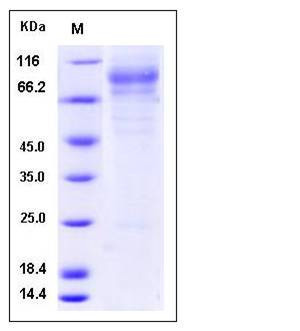 |
| Purity | > 87 % as determined by SDS-PAGE |
| Protein Construction | A DNA sequence encoding human IDS precursor (NP_000193.1) (Met 1-Pro 550) was expressed with a C-terminal polyhistidine tag. |
| Bio-activity | Measured by its ability to hydrolyze the substrate 4-Nitrocatechol Sulfate (PNCS). The specific activity is > 1.0 pmoles/min/μg. |
| Research Area | Immunology |Inflammation / Inflammatory Mediator |Lysosomal Enzymes |
| Formulation | Lyophilized from sterile PBS, pH 7.4 1. Normally 5 % - 8 % trehalose and mannitol are added as protectants before lyophilization. Specific concentrations are included in the hardcopy of COA. |
| Background | Iduronate 2-Sulfatase, also known as IDS, is a member of the highly conserved sulfatase family of enzymes that catalyze the hydrolysis of O- and N-sulfate esters from a variety of substrates. The human Iduronate 2-Sulfatase/IDS consists of a signal peptide, a pro peptide and a mature chain that may be further processed into two chains. Among the identified 18 human sulfatases, Iduronate 2-Sulfatase/IDS is required for the lysosomal degradation of the glycosaminoglycans (GAG), heparan sulfate and dermatan sulfate. Multiple mutations in this X-chromosome localized gene result in Iduronate 2-Sulfatase/IDS enzymatic deficiency, and lead to the sex-linked Mucopolysaccharidosis Type II (MPS II ), also known as Hunter Syndrome characterized by the lysosomal accumulation of the GAG and their excretion in urine. MPS II has a wide spectrum of clinical manifestations ranging from mild to severe due to the level of Iduronate 2-Sulfatase/IDS enzyme. Retroviral-mediated Iduronate 2-Sulfatase/IDS gene transfer into lymphoid cells would be a promising gene therapeutic strategy. |
| Reference |