

Human HCST / DAP10 Protein (Fc Tag)
DAP10,KAP10,PIK3AP
- 100ug (NPP2179) Please inquiry
| Catalog Number | P14063-H05H |
|---|---|
| Organism Species | Human |
| Host | Human Cells |
| Synonyms | DAP10,KAP10,PIK3AP |
| Molecular Weight | The recombinant human HCST/mFc is a disulfide-linked homodimer. The reduced monomer comprises 264 amino acids and has a predicted molecular mass of 29.3 kDa. The apparent molecular mass of the protein is approximately 34 in SDS-PAGE under reducing conditions. |
| predicted N | Gln 19 |
| SDS-PAGE | 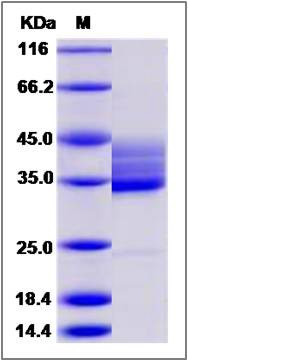 |
| Purity | (67.3+28) % as determined by SDS-PAGE |
| Protein Construction | A DNA sequence encoding the human HCST (Q9UBK5-1) (Met-Pro48) was fused with Fc region of mouse IgG at the C-terminus. |
| Bio-activity | |
| Research Area | Cancer |Signal transduction |Protein Trafficking |Vesicle Transport |Adapters |Transmembrane | |
| Formulation | Lyophilized from sterile PBS, pH 7.4. 1. Normally 5 % - 8 % trehalose, mannitol and 0.01% Tween80 are added as protectants before lyophilization. Specific concentrations are included in the hardcopy of COA. |
| Background | HCST, also known as DAP10, belongs to the DAP10 family. It is a transmembrane signaling adaptor that contains a YxxM motif in its cytoplasmic domain. HCST may be part of the immune recognition receptor complex. This receptor plays a major role in triggering cytotoxicity against target cells expressing cell surface ligands such as MHC class I chain-related MICA and MICB, and UL16-binding proteins (ULBPs). It may activate phosphatidylinositol 3-kinase dependent signaling pathways through its intracytoplasmic YxxM motif. |
| Reference |