

Human GPD1 / Glycerolphosphate Dehydrogenase 1 Protein (His Tag)
GPD-C,GPDH-C,HTGTI
- 100ug (NPP2168) Please inquiry
| Catalog Number | P15489-H07E |
|---|---|
| Organism Species | Human |
| Host | E. coli |
| Synonyms | GPD-C,GPDH-C,HTGTI |
| Molecular Weight | The recombinant human GPD1 consists of 364 amino acids and predicts a molecular mass of 39.4 KDa. It migrates as an approximately 33-37 KDa band in SDS-PAGE under reducing conditions. |
| predicted N | His |
| SDS-PAGE | 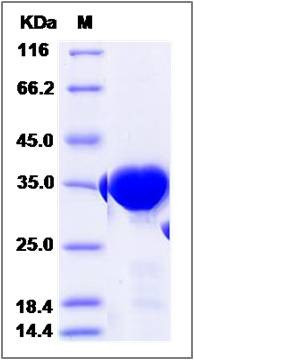 |
| Purity | > 95 % as determined by SDS-PAGE |
| Protein Construction | A DNA sequence encoding the human GPD1(P21695) (Met1-Met349) was expressed with a polyhistidine tag at the N-terminus. |
| Bio-activity | |
| Research Area | Signaling |Signal Transduction |Metabolism |Pathways and Processes |Metabolic signaling pathways |Lipid and lipoprotein metabolism | |
| Formulation | Lyophilized from sterile 50mM Tris, 10% glycerol, pH 8.0. 1. Normally 5 % - 8 % trehalose and mannitol are added as protectants before lyophilization. Specific concentrations are included in the hardcopy of COA. |
| Background | GPD1, also known as glycerolphosphate dehydrogenase 1, is a member of the NAD-dependent glycerol-3-phosphate dehydrogenase family. GPD1 catalyzes the reversible redox conversion of dihydroxyacetone phosphate (DHAP), thus plays a critical role in carbohydrate and lipid metabolism. It also reduces nicotine adenine dinucleotide (NADH) to glycerol-3-phosphate (G3P) and NAD+. Meanwhile, GPD1 and mitochondrial glycerol-3-phosphate dehydrogenase also form a glycerol phosphate shuttle that facilitates the transfer of reducing equivalents from the cytosol to mitochondria. Mutations in GPD1 gene are a cause of transient infantile hypertriglyceridemia. |
| Reference |