

Human Ephrin-A5 / EFNA5 Protein (His Tag)
AF1,EFL5,EPLG7,GLC1M,LERK7,RAGS
- 100ug (NPP1257) Please inquiry
| Catalog Number | P10192-H08H |
|---|---|
| Organism Species | Human |
| Host | Human Cells |
| Synonyms | AF1,EFL5,EPLG7,GLC1M,LERK7,RAGS |
| Molecular Weight | The recombinant human Ephrin-A5 consists of 194 amino acids and has a calculated molecular mass of 23 kDa. In SDS-PAGE under reducing conditions, the apparent molecular mass of rhEphrin-A5 is approximately 27 kDa due to glycosylation. |
| predicted N | Gln 21 |
| SDS-PAGE | 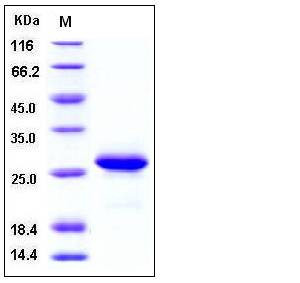 |
| Purity | > 90 % as determined by SDS-PAGE |
| Protein Construction | A DNA sequence encoding the extracellular domain (Met 1-Asn 203) of human Ephrin-A5 (NP_001953.1) precursor was expressed with a C-terminal polyhistidine tag. |
| Bio-activity | Measured by its binding ability in a functional ELISA . Immobilized human EPHA5 at 20 μg/ml (100 μl/well) can bind human EFNA4 with a linear ranger of 1.28-32 ng/ml. |
| Research Area | Cell Biology |Cell Cycle |Cell Differentiation |
| Formulation | Lyophilized from sterile PBS, pH 7.4 1. Normally 5 % - 8 % trehalose, mannitol and 0.01% Tween80 are added as protectants before lyophilization. Specific concentrations are included in the hardcopy of COA. |
| Background | Ephrin-A5 also known as EFNA5, is a member of the Ephrin family. The Eph family receptor interacting proteins (ephrins) are a family of proteins that serve as the ligands of the Eph receptor, which compose the largest known subfamily of receptor protein-tyrosine kinases (RTKs). Ephrin subclasses are further distinguished by their mode of attachment to the plasma membrane: ephrin-A ligands bind EphA receptors and are anchored to the plasma membrane via a glycosylphosphatidylinositol (GPI) linkage, whereas ephrin-B ligands bind EphB receptors and are anchored via a transmembrane domain. Ephrin-A5/EFNA5 may function actively to stimulate axon fasciculation. The interaction of EFNA5 with EPHA5 also mediates communication between pancreatic islet cells to regulate glucose-stimulated insulin secretion. Ephrin-A5/EFNA5 also serves as a cognate/functional ligand for EPHA7, their interaction regulates brain development modulating cell-cell adhesion and repulsion. |
| Reference |