

Human ETHE1 / HSCO Protein (His Tag)
HSCO,YF13H12
- 100ug (NPP2122) Please inquiry
| Catalog Number | P14681-H07E |
|---|---|
| Organism Species | Human |
| Host | E. coli |
| Synonyms | HSCO,YF13H12 |
| Molecular Weight | The recombinant human ETHE1 consists of 257 amino acids and predicts a molecular mass of 28.3 KDa. It migrates as an approximately 28 KDa band in SDS-PAGE under reducing conditions. |
| predicted N | His |
| SDS-PAGE | 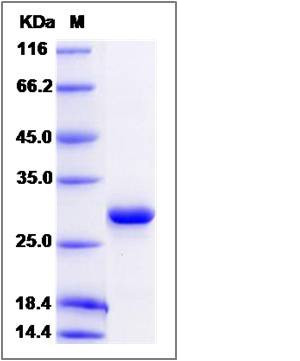 |
| Purity | > 90 % as determined by SDS-PAGE |
| Protein Construction | A DNA sequence encoding the human ETHE1 (O95571) (Leu13-Ala254) was expressed with a polyhistidine tag at the N-terminus. |
| Bio-activity | |
| Research Area | Developmental Biology |Post embryonic development |Cellular Senescence & Aging |Apoptosis |
| Formulation | Lyophilized from sterile PBS, pH 7.4. 1. Normally 5 % - 8 % trehalose and mannitol are added as protectants before lyophilization. Specific concentrations are included in the hardcopy of COA. |
| Background | ETHE1, also known as HSCO, is a sulfur dioxygenase that localizes within the mitochondrial matrix. ETHE1 probably plays an important role in metabolic homeostasis in mitochondria. It may also function as a nuclear-cytoplasmic shuttling protein that binds transcription factor RELA/NFKB3 in the nucleus and exports it to the cytoplasm. ETHE1 can suppresses p53-induced apoptosis by preventing nuclear localization of RELA. Mutations in ETHE1 gene result in ethylmalonic encephalopathy. Ethylmalonic encephalopathy is an autosomal recessive, invariably fatal disorder characterized by early-onset encephalopathy, microangiopathy, chronic diarrhea, defective cytochrome c oxidase (COX) in muscle and brain, high concentrations of C4 and C5 acylcarnitines in blood and high excretion of ethylmalonic acid in urine. |
| Reference |