

Human ECSIT Protein (His Tag)
SITPEC
- 100ug (NPP2093) Please inquiry
| Catalog Number | P14497-H07E |
|---|---|
| Organism Species | Human |
| Host | E. coli |
| Synonyms | SITPEC |
| Molecular Weight | The recombinant human ECSIT consists of 201 amino acids and predicts a molecular mass of 22.9 KDa. It migrates as an approximately 25 KDa band in SDS-PAGE under reducing conditions. |
| predicted N | His |
| SDS-PAGE | 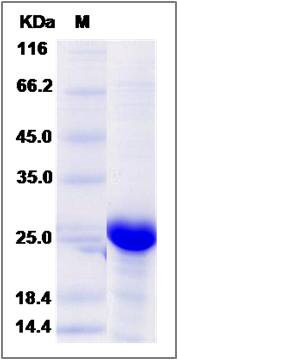 |
| Purity | > 90 % as determined by SDS-PAGE |
| Protein Construction | A DNA sequence encoding the human ECSIT (Q9BQ95-1)(Glu246-Ser431) was expressed with a polyhistidine tag at the N-terminus. |
| Bio-activity | |
| Research Area | Signaling |Signal Transduction |Other Related Intracellular Topics |NF-kB (NFkB) Pathway |
| Formulation | Lyophilized from sterile 50mM Tris, 10% Glycerol, pH 8.0. 1. Normally 5 % - 8 % trehalose and mannitol are added as protectants before lyophilization. Specific concentrations are included in the hardcopy of COA. |
| Background | ECSIT is an adapter protein of the toll-like and IL-1 receptor signaling pathway that is involved in the activation of NF-kappa-B via MAP3K1. Activation of NF-kappaB as a consequence of signaling through the Toll and IL-1 receptors is a major element of innate immune responses. ECSIT is specific for the Toll/IL-1 pathways and is a regulator of MEKK-1 processing. It bridges TRAF6 to MEKK-1. Expression of wild-type ECSIT accelerates processing of MEKK-1, whereas a dominant-negative fragment of ECSIT blocks MEKK-1 processing and activation of NF-kappaB. ECSIT is also required for normal embryonic development and efficient assembly of mitochondrial NADH:ubiquinone oxidoreductase. |
| Reference |