

Human BPHL Protein (His Tag)
BPH-RP,MCNAA,VACVASE
- 100ug (NPP1934) Please inquiry
| Catalog Number | P13675-H07E |
|---|---|
| Organism Species | Human |
| Host | E. coli |
| Synonyms | BPH-RP,MCNAA,VACVASE |
| Molecular Weight | The recombinant human BPHL consists of 268 amino acids and predicts a molecular mass of 30.7 KDa. It migrates as an approximately 31 KDa band in SDS-PAGE under reducing conditions. |
| predicted N | His |
| SDS-PAGE | 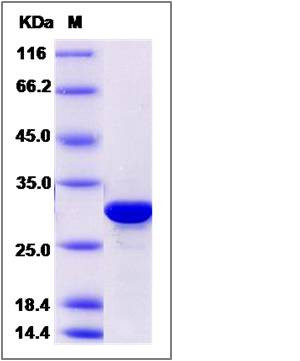 |
| Purity | > 95 % as determined by SDS-PAGE |
| Protein Construction | A DNA sequence encoding the mature form of human BPHL (Q86WA6-1) (Ser38-Gln291) was expressed with a polyhistide tag at the N-terminus. |
| Bio-activity | |
| Research Area | Cardiovascular |Cardiovascular disease Therapeutic Targets |Coronary Artery Disease Therapeutic Targets |
| Formulation | Lyophilized from sterile 20mM Tris, 50mM NaCl, 10% glycerol, pH 8.0 1. Normally 5 % - 8 % trehalose, mannitol and 0.01% Tween80 are added as protectants before lyophilization. Specific concentrations are included in the hardcopy of COA. |
| Background | BPHL is a member of the serine protease family. BPHL is expressed large quantities in liver and kidney and in minor quantities in heart, intestine and skeletal muscle. BPHL is a specific alpha-amino acid ester hydrolase that prefers small, hydrophobic, and aromatic side chains and does not have a stringent requirement for the leaving group other than preferring a primary alcohol. It catalyzes the hydrolytic activation of amino acid ester prodrugs of nucleoside analogs such as valacyclovir and valganciclovir. BPHL also activates valacyclovir to acyclovir. It may play a role in detoxification processes. |
| Reference |