

Human Alpha-2-glycoprotein / AZGP1 Protein (His Tag)
ZA2G,ZAG
- 100ug (NPP1891) Please inquiry
| Catalog Number | P13242-H08H |
|---|---|
| Organism Species | Human |
| Host | Human Cells |
| Synonyms | ZA2G,ZAG |
| Molecular Weight | The recombinant human AZGP1 comprises 289 amino acids and has a predicted molecular mass of 33.6 kDa. The apparent molecular mass of the protein is approximately 41 kDa in SDS-PAGE under reducing conditions. |
| predicted N | Gln 21 |
| SDS-PAGE | 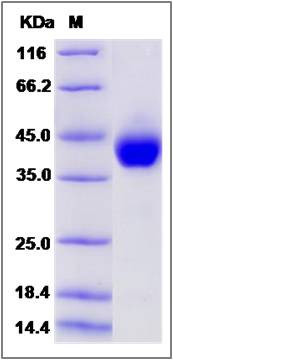 |
| Purity | > 95 % as determined by SDS-PAGE |
| Protein Construction | A DNA sequence encoding the human AZGP1 (P25311) (Met1-Ser298) with a C-terminal polyhistidine tag was expressed. |
| Bio-activity | |
| Research Area | Signaling |Signal Transduction |Metabolism |Lipid metabolism |
| Formulation | Lyophilized from sterile PBS, pH 7.4 1. Normally 5 % - 8 % trehalose, mannitol and 0.01% Tween80 are added as protectants before lyophilization. Specific concentrations are included in the hardcopy of COA. |
| Background | Alpha-2-glycoprotein, also known as AZGP1, belongs to the MHC class I family. It can be detected in body fluids such as serum, sweat, and seminal and breast cyst fluids. It has been shown that alpha-2-glycoprotein can stimulate lipolysis by adipocytes in vivo and in vitro. Thus it is believed that alpha-2-glycoprotein plays an important role in the regulation of body weight, and age-dependent changes in genetically influenced obesity, and it also regulates melanin production by normal and malignant melanocytes. Alpha-2-glycoprotein is produced by both white and brown fat adipocytes and may act in a local autocrine fashion in the reduction of adiposity in cachexia. |
| Reference |