

Human APLP1 / Amyloid-like protein 1 Protein (His Tag)
APLP
- 100ug (NPP1902) Please inquiry
| Catalog Number | P13716-H08H |
|---|---|
| Organism Species | Human |
| Host | Human Cells |
| Synonyms | APLP |
| Molecular Weight | The recombinant human APLP1 consists of 553 amino acids and predicts a molecular mass of 61.9 KDa. It migrates as an approximately 67-77 KDa band in SDS-PAGE under reducing conditions. |
| predicted N | Ser 39 |
| SDS-PAGE | 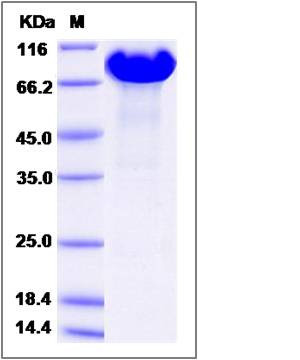 |
| Purity | > 95 % as determined by SDS-PAGE |
| Protein Construction | A DNA sequence encoding the human APLP1 (P51693-1) (Met1-Glu580) was expressed with a polyhistidine tag at the C-terminus. |
| Bio-activity | |
| Research Area | Immunology |Signal Transduction |Other Signal Transduction Molecules |
| Formulation | Lyophilized from sterile PBS, PH 7.4. 1. Normally 5 % - 8 % trehalose and mannitol are added as protectants before lyophilization. Specific concentrations are included in the hardcopy of COA. |
| Background | APLP1, also known as amyloid-like protein 1, is a member of the highly conserved amyloid precursor protein gene family. APLP1 is a membrane-associated glycoprotein that is cleaved by secretases in a manner similar to amyloid beta A4 precursor protein cleavage. APLP1, together with APLP2, are important modulators of glucose. APLP1 may also play a role in synaptic maturation during cortical development. Alternatively spliced transcript variants encoding different isoforms have been described. APLP1 also is a mammalian homologue of amyloid precursor protein (APP). APP is a type I membrane protein that is genetically linked to Alzheimer's disease. |
| Reference |